- 3 July, 2026
PROTECTING KIDS FROM ULTRAVIOLET (UV) EXPOSURE: A Must for the African Sun
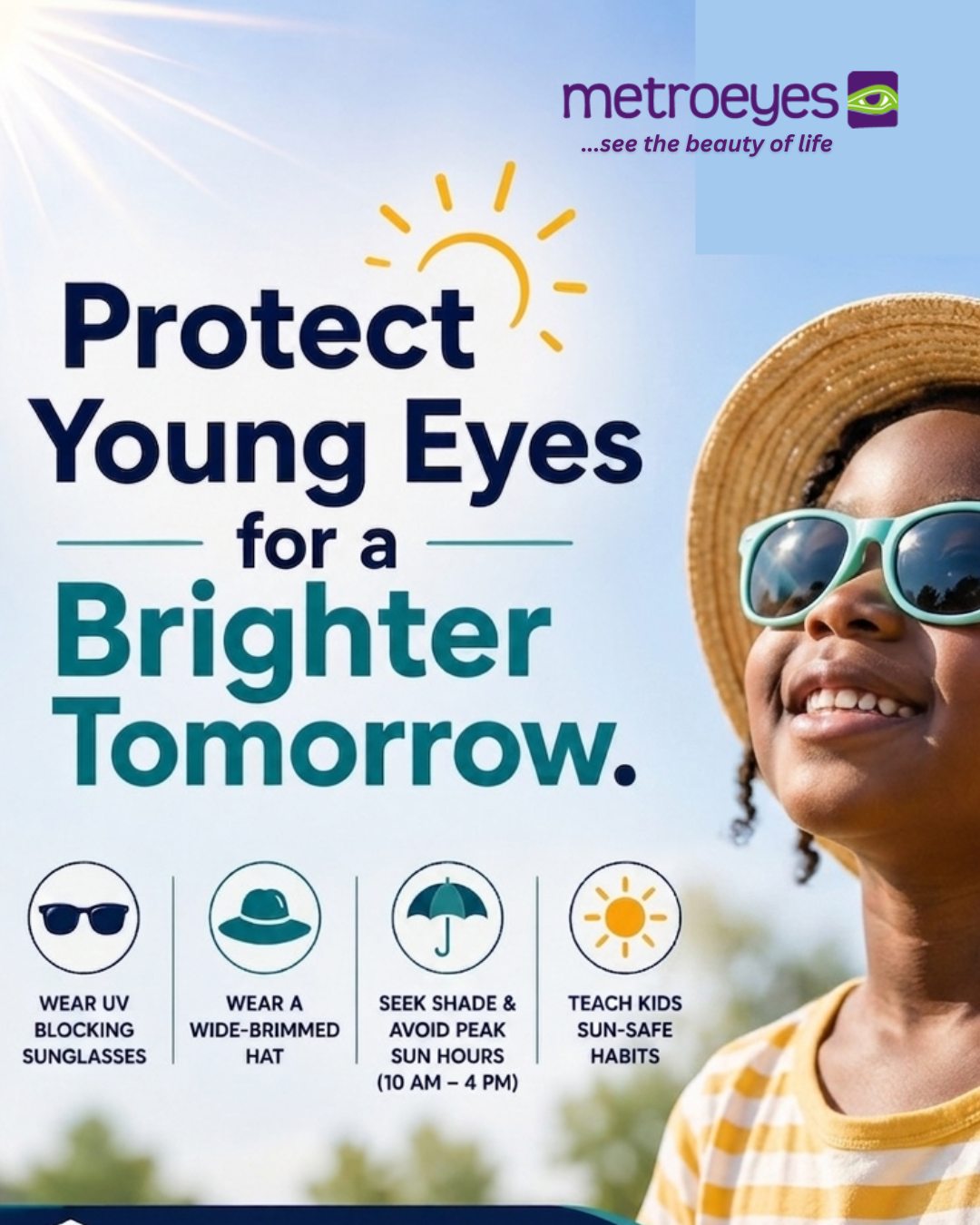
PROTECTING KIDS FROM ULTRAVIOLET (UV) EXPOSURE: A
Must for the African Sun
When preparing children for a day outdoors, most parents remember hats or skin protection but completely overlook a crucial detail: their eyes.
In Sub-Saharan Africa, our geographic location near the equator subjects us to high, year-round ambient solar radiation. Because children’s eyes are still developing, they absorb significantly more UV radiation than adults, making early eye protection a medical necessity rather than a fashion choice.
Why the African Sun Demands Action
The high UV index characteristic of our climate accelerates
long-term ocular damage.
The clinical numbers underscore the reality of this environmental exposure:
- The Child Vulnerability: A child's natural lens is perfectly clear, allowing up to 70% more UV radiation to reach the delicate retina compared to an adult eye, which filters light more efficiently.
- The Pterygium Belt: Sub-Saharan Africa sits directly within what ophthalmologists call the "pterygium belt." Recent meta-analyses show a pooled pterygium prevalence of 18% across Africa, a condition heavily accelerated by early, unprotected exposure to high UV, dust, and wind.
- The Burden of Blindness: According to data from the World Health Organization (WHO) and regional blindness surveys, cataract remains the leading cause of blindness in Nigeria, accounting for over 43% of cases. The WHO estimates that up to 10% of global cataract cases are directly attributable to lifetime cumulative UV exposure.
How Chronic UV Exposure Damages Young Eyes
Sun damage to the visual system behaves like a financial
debt—it accumulates silently over time.
Short-Term Risks:
Photokeratitis: Essentially a "sunburn of the cornea." After a long day playing under intense sunlight, children may experience painful, red, watery eyes and acute light sensitivity
Long-Term Risks:
- Cataracts: Premature clouding of the eye’s natural lens.
- Pterygium (Surfer’s Eye): A fleshy, disfiguring
growth that creeps across the white of the eye onto the cornea, often requiring
surgical intervention if it blocks the visual axis.
- Ocular Surface Squamous Neoplasia (OSSN): Severe, chronic UV damage in tropical regions increases the long-term risk of localized eye cancers.
Actionable UV Protection Strategy for Parent
- Invest in Certified UV Eyewear: Look explicitly for children's sunglasses labeled UV400 or 100% UV Protection (blocking both UVA and UVB rays). Dark, cheap plastic fashion glasses without UV filters are dangerous; they cause the pupil to dilate, letting more harmful light into the eyes
- Leverage Wide-Brimmed Hats: A wide-brimmed sun hat or standard structured cap blocks up to 50% of UV radiation from hitting the eyes from overhead angles
- Respect Peak Solar Hours: The UV index in Sub-Saharan Africa peaks dramatically between 10:00 a.m. and 4:00 p.m. When possible, encourage indoor or shaded play during these intense mid-day hours.
- Educate Against Direct Gaze: Teach children never to look directly at the sun. Direct solar exposure can cause permanent thermal damage to the macula (solar retinopathy) in a matter of seconds.
The Takeaway
Ocular UV damage is entirely preventable, but protection
must start in childhood. By establishing simple sun-safety habits today, you
safeguard your child's vision for a lifetime.
Does your child spend hours outdoors? Ensure their eyes are
developing safely. Visit your nearest MetroEyes clinic for a comprehensive
pediatric eye examination and expert guidance on UV-protective eyewear tailored
for children.
You are a few steps away from a clearer future