- 4 February, 2026
The Heart-Eye Connection: Why Your Vision Depends on Your Pulse
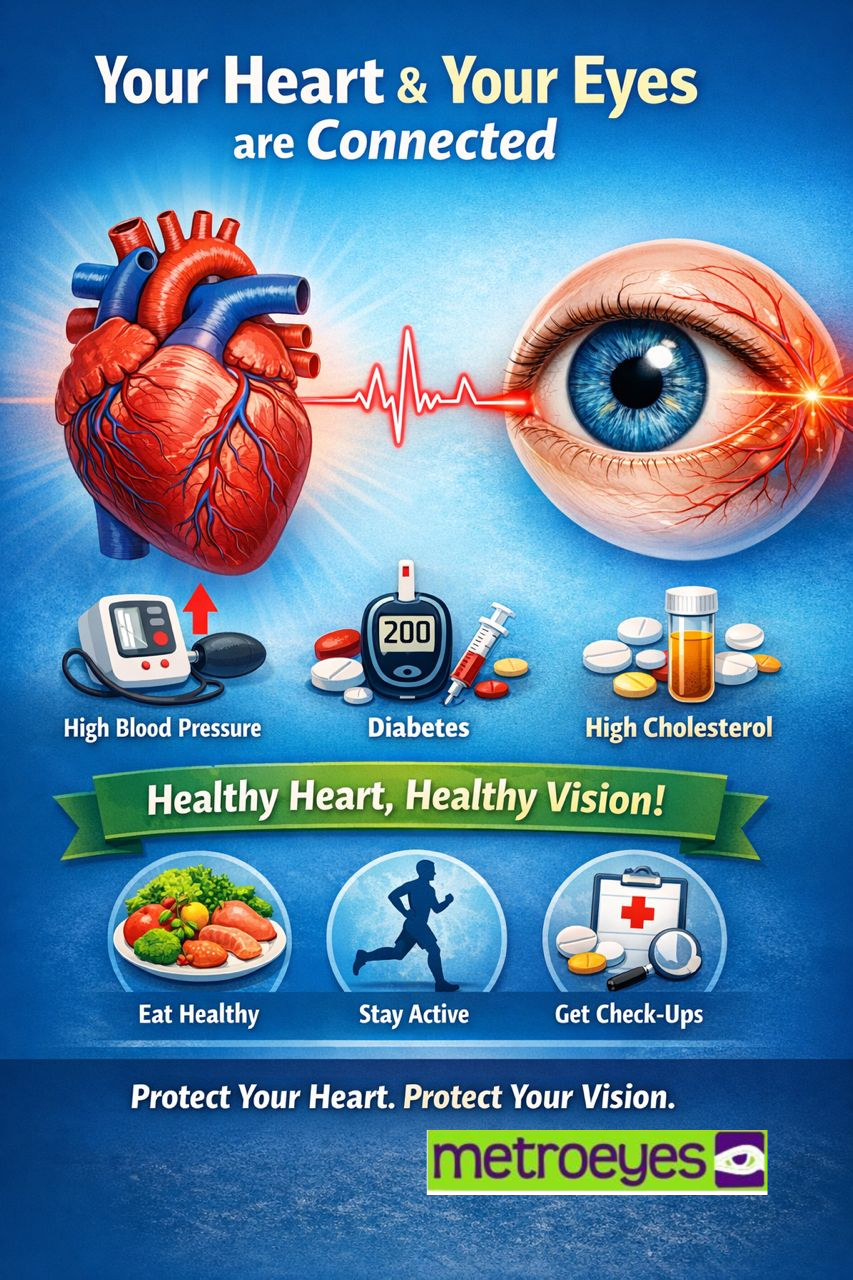
When we think of heart health, we think of the chest. When we think of eye health, we think of our glasses. But in reality, your heart and your eyes are part of the same complex "plumbing" system.
Your eyes are packed with some of the smallest, most
delicate blood vessels in your body. If your heart is the pump, your eyes are
the high-pressure gauges at the end of the line. When the pump struggles, the
gauges are often the first to show the damage.
1. The "Silent" Indicators
Conditions like high blood pressure (hypertension) often
have no symptoms until it’s too late—which is why it’s called the "silent
killer." However, your eyes aren't so quiet.
- The
Human Touch: Imagine your blood vessels as garden hoses. High blood
pressure is like turning the water on at a force the hose wasn't built
for. Eventually, the hose cracks or leaks. In your eyes, this leads to Hypertensive
Retinopathy, which can cause blurred vision or even permanent
scarring.
- The
Hard Fact: A study published in the Journal of the American Heart
Association found that people with retinal vascular changes are at a significantly
higher risk of suffering a stroke or heart failure within the next ten
years. Your eye exam might actually be a life-saving early warning system
for your heart.
2. Cholesterol and the "Silver Wire" Effect
High cholesterol doesn't just clog the large arteries in
your legs or heart; it can build up in the tiny vessels of the eye.
- What
we see: During a dilated eye exam, specialists can sometimes see
"Hollenhorst plaques"—tiny clumps of cholesterol—lodged in the
retinal arteries.
- The
Reality: If cholesterol is visible in your eyes, it is a clear sign
that your cardiovascular system needs immediate attention to prevent a
"stroke of the eye" (Central Retinal Artery Occlusion), which
causes sudden, painless vision loss.
3. Diabetes: The Shared Enemy
Diabetes is a "double-threat" disease. It weakens
the walls of the blood vessels throughout the body, leading to both heart
disease and Diabetic Retinopathy.
- The
Data: About 1 in 3 people with diabetes over the age of 40
already have some signs of retinopathy. Because poor blood sugar
management affects the heart’s ability to pump efficiently, it creates a
"bottleneck" that starves the retina of oxygen.
3 Ways to Love Your Heart (and Your Sight)
You don’t have to be an athlete to protect your vision. It
starts with small, daily choices that keep the "pipes" clean and the
"pump" strong.
|
Action Item |
Why it Works for Your Eyes |
|
Colorful Eating |
Leafy greens and Omega-3s (fish) reduce arterial plaque
and protect the macula. |
|
Movement |
Just 30 minutes of brisk walking lowers intraocular
pressure (IOP) by up to 20%. |
|
The Annual Exam |
A comprehensive eye exam can detect signs of heart disease
before your GP does. |
Takeaway
Protecting your vision isn't just about getting a stronger
prescription; it's about honoring the vessel that carries you. When you
exercise, eat well, and manage your stress, you aren't just helping your
heart—you’re ensuring that you can see the world clearly for decades to come.
Next time you visit us at Metroeyes, ask us: "How do
my blood vessels look?" We’re happy to give you a status report on your
heart’s favorite window.
You are a few steps away from a clearer future